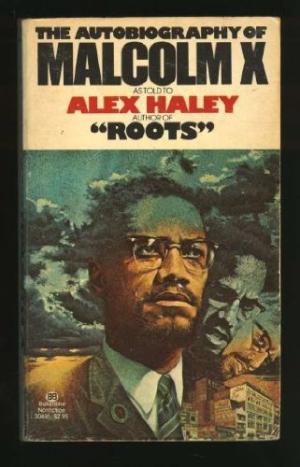
What’s your opinion of Malcolm X? What impression have you gotten? Do you remember where you got it from?
Depending on the mind, the mention of Malcolm’s name can bring forth images from a righteous, principled, heroic revolutionary, to an angry, hatemongering black supremacist.
In a word, I always figured he was a very intense person. I vaguely remember that from the trailer of the biopic starring Denzel Washington, but I was pretty young when that aired. From a more recent visit to the Civil Rights Museum in Memphis I learned that he thought Martin Luther King Jr. was a “chump.”
Coincidentally, this last MLK Day I finished Malcolm X’s autobiography. Now, unexpectedly, I know a lot more about Malcolm than I do Martin. (Please, if you’ve read one, recommend a good book on Dr. King.)
I’d like to review the book, not the man – though what better report of a man can there be than his own autobiography? I guess then I’m sharing my opinion of what I’ve learned about Malcolm’s life, from his book; I’ve purposely withheld from learning more about him from other sources for now.
I cherish the ability to form my own opinions based off an original source. If someone paraphrases something a politician or celebrity said or did, colored by their own opinion, I consider it, but am much more interested in tracking down original quotes or clips in context and interpreting it for myself.
Based on the heavy nature of 2016’s predominant political and social discussions I aimed to read four books last year, books I’d never read, whose historical subjects figured so prominently into the topics of the present: The Bible, The Quran, Mein Kampf, and The Autobiography of Malcolm X. I don’t think I need to explain the pertinence or modern significance of these books.
With these subjects so casually tossed into conversation, I’m ashamed that I don’t know more about them, especially with how easily copies of books can be tracked down. Scholars have devoted their entire lives to understanding and interpreting the meaning of religions’ central texts, though, so I admit I’m reluctant to try the Bible or Quran, but I did procure copies of the other two books. (Also, I’m a slow, er, careful reader, and for some cosmic balance I always juggle multiple books – fiction, non-fiction, something dry about art/life/philosophy, comics, etc.)
Faced with the choice of reading the words of either Malcolm X or Adolf Hitler, especially if I hoped to read the book in public, I realized that however academically and critically I hope to try and read Mein Kampf I’d definitely feel embarrassed, if not begging for negative reactions, by reading it in a cafeteria or while donating plasma. Shoot, I’d definitely be shocked at someone publicly reading Hitler, and I don’t know if I’d be comfortable asking them why they wanted to read such a book, even though I know why I’d want to read it: to try and learn how a person could go so horribly wrong while pursuing what they thought was right. I don’t know if I’ll find that in Mein Kampf, but I have this theory that a book written by a bad person can be used as a tool for good – something of a “how not-to” manual. Then again, by that notion, Charles Manson’s music doesn’t seem to offer any real insight.
Wish me luck if I ever get to that one. I chose The Autobiography of Malcolm X first.
(*SPOILERS GALORE AHEAD* — The book’s 50 years old, but I sure hate spoilers. Perhaps a more important warning is my inconsistency in citing specifics; I didn’t think to write this until I was almost done with the book.)
Off the bat, it was a very interesting read. Malcolm’s Michigan childhood was tragic, with destitution, his dad murdered, and he and his handful of siblings forced from their mother’s custody by the state. Young Malcolm’s determination and intelligence are objectively inspiring.
After leaving school he moved to the east coast to live with an older sister, working at a night club shining shoes. It’s fascinating to read someone’s stories of what entertainment and entertainers were like back then, and just the night life in general. So much action! Really fun, lively times between old Boston and New York.
Malcolm’s coworkers turned him on to more illicit means of making money, a.k.a. hustling. Drugs, pimping, the like. Dude got corrupted quickly. Out of his shell, flush with easy cash, flashily dressed, and armed with newly acquired dance skills and slang, Malcolm had a whole lot of fun employing it all. But the focus on money got him into trouble with other hustlers, and the drugs he got addicted to turned him paranoid and miserable. He became a full-time thief, and eventually got busted and sentenced to a very long time in prison.
Locked up and painfully sober, he was so mean he earned the nickname “Satan.” Malcolm’s education began in prison, though. I’m a fan of autodidactism, and Malcolm absolutely inhaled the books in the prison’s exceptionally stocked library. (I’ve always felt that that’d be the only potentially enjoyable part of a long sentence.)
One of his brothers wrote to him about the Nation of Islam. He glommed onto the rhetoric very quickly, and with growing intensity this became the new lens through which he learned. White people rapidly became “the devil” to him. He recalled all of his experiences with white people growing up, and retroactively confirmed this judgment – though he skips over all the white people who genuinely cared for him, including a long-term girlfriend from Boston.
I should mention that the Nation of Islam’s “history” of the creation of the evil white race is outrageous enough to make L. Ron Hubbard blush. In short, long ago, a mad scientist named Mr. Yacub took black men into a cave and turned them evil while lightening their skin tone over centuries. Yep!
Malcolm’s mind was made up, though, and he passionately took to the Nation of Islam and its leader, Elijah Muhammad, almost as if he’d replaced a chemical addiction with an ideological one. (We see that all the time with the seeking of a “higher power” in the 12-step addiction recovery program.) After prison he gets very tight with Mr. Muhammad, travels all over, setting up new temples, recruiting members, gaining prominence, giving speeches and interviews spreading his beliefs.
Most of the middle of the book was difficult to read. Malcolm had some unflattering if not vicious opinions regarding women, Jews, biracial people, and of course white people. A huge point of his contention with MLK – whom he indirectly references throughout the book, but only mentions by name toward the very end – was racial integration. The epilogue even had an anecdote of Malcolm taking cream with his coffee – “the only thing he likes integrated,” was his comment. He was also incredibly cynical about the March (“Farce,” as he calls it) on Washington.
At one point he talks about a white college student finding him in Harlem after he’d spoken at her campus – she’d traveled from the south because she was so concerned with his message. She explains her journey and how deeply ashamed she felt of her ancestors’ irreparable crimes against black people, and implores, “What can I do?” His reply? “Nothing!” To his stern satisfaction she ran out crying. He offered no solutions beyond segregation at this point, entertaining the formation of one or more black ethnostates in the US.
Perhaps his most despicable moment came after he celebrated to the press when he learned of a plane crash that killed its 30 white passengers.
The majority of the book presents this stage of Malcolm’s mindset: anti-white, pro-Nation of Islam, with these two prongs inextricably linked. Somedays it was real work to read; it’s tough to take someone seriously when their hatred of people with a certain skin color is so central to their ideology. But the hypocrisy was tough, too; he complains of the media making a scapegoat of him, while he often does the same of white people.
Indisputably, the book maintains a striking sincerity and honesty throughout. It was written as Malcolm told it to journalist/author Alex Haley (who later wrote Roots). Malcolm’s opinions evolve a great deal over the years that Haley wrote the book with him, and Malcolm later agreed to leave his former opinions intact; Haley correctly suggested the book would be more effective if it displayed Malcolm’s evolution. If you haven’t read the book and plan to, I regret if I’ve spoiled that, but I think it’s incredibly important.
Eventually, Malcolm is made a scapegoat by Elijah Muhammad and the Nation of Islam. He seems to handle his excommunication with real honor, in spite of what he learns of his former leader on the way out. After his split he pursues Islam more directly – the best I can do to explain the difference between the Nation of Islam and Islam is the former is Islam plus “white people are the devil.” He embarks on a pilgrimage to Mecca, and meets Muslim and world leaders who had followed his story internationally. And on this pilgrimage, witnessing white, blonde-haired, blue-eyed Muslims and Muslims of all physical appearances, he sheds his segregationist mentality.
In a sense, at least; he gains the mindset that all people should unite under Islam, going so far as suggesting Islam should govern society. On the one hand it’s beautiful that he witnesses racial harmony for the first time, but this all but leads him to favor segregation by religion instead of race.
I should admit that I am not religious. I abide some form of secular morality and whatever else I listed in my second post. I’m not here to try and work out or justify my current non-relationship with religion, but I feel the need to mention it because religion figures so prominently into Malcolm’s life. Also, lest I be labeled an Islamophobe, know that my non-participation in all religions is totally equal. I can’t rule it out, but for now I feel fortunate that my parents never pushed religion on me.
I can’t know if my personal non-religiousness figures into my support of a separation of church and state. I hope it doesn’t. But I do feel it’s the most maximally free way to run a country, and therefore disagree with his suggestion that Islam or any religion should rule a country.
More so, I’m bothered when I read between the lines: if Malcolm believed an Islam-based government (he never uses the term Sharia) is the only means of racial harmony, is he not inferring that people who aren’t religious are inherently racist?
Forgive me if I’m not eager to accept a requisite link regarding religion and racism. He makes a more general statement, though, that I find tougher to disagree with:
“Truly a paradise could exist wherever material progress and spiritual values could be properly balanced.”
Of course, seeking such an ill-defined, detail-deficient paradise is probably what’s driven so many wars for so long. Sounds nice, though.
In loosening his hard line against white people, Malcolm redefines “whiteness” as an attitude more than a skin tone. Why, then, continue to use the skin tone to describe the attitude? Why not use another word, perhaps “bigotry,” that people of all skin tones are capable of?
Maybe he would have gone on to better articulate this. What I might admire most about Malcolm X, or Al-Hajj Malik El-Shabazz as he was known post-pilgrimage, was his positively evolving societal outlook. Even though he was seriously ostracized and misunderstood by the end of his life, he appeared to be headed in a positive direction.
I hate that he was assassinated. Members of the Nation of Islam took everything from him, slandered his name, blew up his house, and committed as much damage to him as possible. Finally, at one of his speeches, shortly after he took the stage and addressed the crowd, multiple Nation of Islam members rose from the audience, drew their guns, and shot him to death. Violence is never, ever the way to deal with different opinions (no, not even with neo-Nazis; perhaps more on that in a future post).
At my most optimistic, I fear we lost a powerful voice that could have gone on to deeply, positively affect race relations. I hate that we’ll never know.
I’ll continue my optimism and discuss what I liked about Malcolm. I’m not worried about sounding like Justin Trudeau eulogizing Fidel Castro, or John Service describing Chairman Mao, because Malcolm was much different. As controversial as he may have been, based on my knowledge – again, limited only to whatever he told Haley for this book – Malcolm never directly called for violence. You could argue young Malcolm X’s rhetoric, in the twisted minds of some people, led to destruction, violence, and death. But he certainly wasn’t in charge of a country and in a position where he could order death or imprisonment to dissidents like Castro or enact policies that killed millions like Mao.
I liked that Malcolm was such a motivated learner. I think the more he learned and experienced, the more his mind was opened. His heart opened more, too; privately, though not publicly, he later expressed regret for his harshness and cruelty regarding the plane crash and the lady in the diner. Malcolm could have stayed angry his entire life, and even found ways to personally benefit from stoking anger in others, but I think he was genuine in his pursuit of societal harmony, radical as it may have been. Again, I wish we could have seen where he wound up.
He was eager to engage in discourse. Sure, he may have had a combative edge to his debates, but he would field a question or comment from anyone. He fully utilized his freedom of speech. He did, however, allow his supporters to drive out dissenters from crowds at his speeches, but since they were private events he was within his rights.
I like that he was politically independent. He detested both political parties, feeling like neither cared about people, but gave the republicans “credit” for at least being honest and forthright in their disdain. I liked his skepticism, and his understanding that social and political movements can be compromised or corrupted, if not co-opted by those who bankroll them.
And again, I respect his honesty, and restraint from going back and rewriting this book when it must’ve been very tempting (looking at you, Lucas and Spielberg), especially as he found himself further alienated.
What I didn’t like was his proclivity for the collectivism that largely informs the concept racism. He acknowledged a number of “good” white individuals, but condemned us as a whole.
“Here in the United States, notwithstanding those few ‘good’ white people, it is the collective 150 million white people whom the collective 22 million black people have to deal with!”
In response, since it was Spike Lee who made the “Malcolm X” biopic, I’ll cite another Spike joint, “Do the Right Thing”, and the great scene where Mookie (who’s black) takes Pino (who’s white) to task over Pino’s overall prejudice against black people, in spite of his favorite musicians, athletes, and comedians all being black. Mookie points out individual positive examples to defy Pino’s collectively negative prejudice. Why is that so hard for some people?
In closing, I recommend the book and I’m very glad I read it. Part of why I want to throw these radical texts at myself is to see how my principles withstand, and what my reactions teach me about myself. Malcolm’s autobiography deepened my understanding of a prominent figure of 20th century America, and even of the era itself. Any story of a famous person who is feared or revered, influential or ostracized, is naturally interesting, but specifically I appreciated these aspects of the book:
- His rise out of crime and addiction.
- His candid discussion of his recruitment methods, whether hustling or for his religion.
- His self-education and competitive debating while in prison.
- His account of his pilgrimage.
- His difficulty getting into another country – very different situations, but this still hit home; I was stuck at the airport in Slovakia in 2015, alone with staff while they argued in rapid, mumbled Slovak over my entry without ever addressing or even looking at me, just occasionally glancing at my passport. I’d never felt, nor physically been so far from home. After an eternity they tossed me my unstamped passport, without a word, and sort of let me just walk through.
- His dealing with demonization, ostracization, and justifiable paranoia.
- His religious faith.
- Again, his honesty.
Pretty please, let me know what you think! These were just my independent opinions. And like I said, I didn’t cite many specific details or quotes, so if something doesn’t add up that could be why; I’ve been living with this book for months and might have omitted something because it’s obvious to me. If you’ve read it and interpreted something different than I did, or if you have any recommendations for further research, please share!
I hope you learned something and will be inspired to learn more. The following rabbit holes call to me: Martin Luther King Jr., Elijah Muhammad, Louis Farrakhan, and of course more on Malcolm.
Thank you very much for reading! Holler,
-Matty

 Matthew t Day